
How to Get a NIE in Madrid (Step by Step, Without Losing Your Mind)
If you’re trying to settle into life in Madrid, the NIE is usually the first wall you hit.
It feels urgent.
Everyone says you need it.
No one explains it clearly.
The truth is: it’s doable, but Spain doesn’t make it intuitive.
This guide walks you through how to get a NIE in Madrid, step by step, based on how it actually works on the ground. Not the perfect version. The real one.
This isn’t hard, but it is particular.
What a NIE Is (Plain English)
A NIE is your Número de Identidad de Extranjero.
In real life terms, it’s a personal ID number Spain uses to track you in its systems.
You’ll need it to:
Work or freelance
Rent long-term
Open most Spanish bank accounts
Pay taxes
Buy property
Do almost any official admin
What it is not:
Not a visa
Not residency
Not a physical card on its own
The number itself is for life, even if your visa or residence card expires later.
Do You Actually Need a NIE?
This part causes unnecessary panic, so let’s simplify it.
You need a NIE if you:
Work or plan to work in Spain
Stay long-term
Sign contracts (rent, utilities, employment)
Buy property
Deal with taxes or social security
You might not need one yet if you:
Are visiting short-term
Aren’t working
Don’t need to sign anything official
If you don’t need it immediately, it’s okay to wait.
You’re not behind.
NIE vs TIE (Quick Clarity)
These two get mixed up constantly.
NIE = the number
TIE = the physical residence card
If you apply for residency, your NIE is usually assigned as part of the TIE process.
If you just need the number for admin (bank, contract, paperwork), you’re applying for a standalone NIE.
Madrid offices often use the terms interchangeably.
It’s confusing. You didn’t miss something.
Where You Get a NIE in Madrid
NIEs are handled by:
Policía Nacional
Oficinas de Extranjería (Foreigner Offices)
Important things people overlook:
You must book an appointment for Madrid
You can’t go to just any office in Spain
Different Madrid offices vary a lot in pace and strictness
Some are efficient.
Some are slow.
All are official.
Step-by-Step: How to Get a NIE in Madrid
Step 1: Know Which NIE You’re Applying For
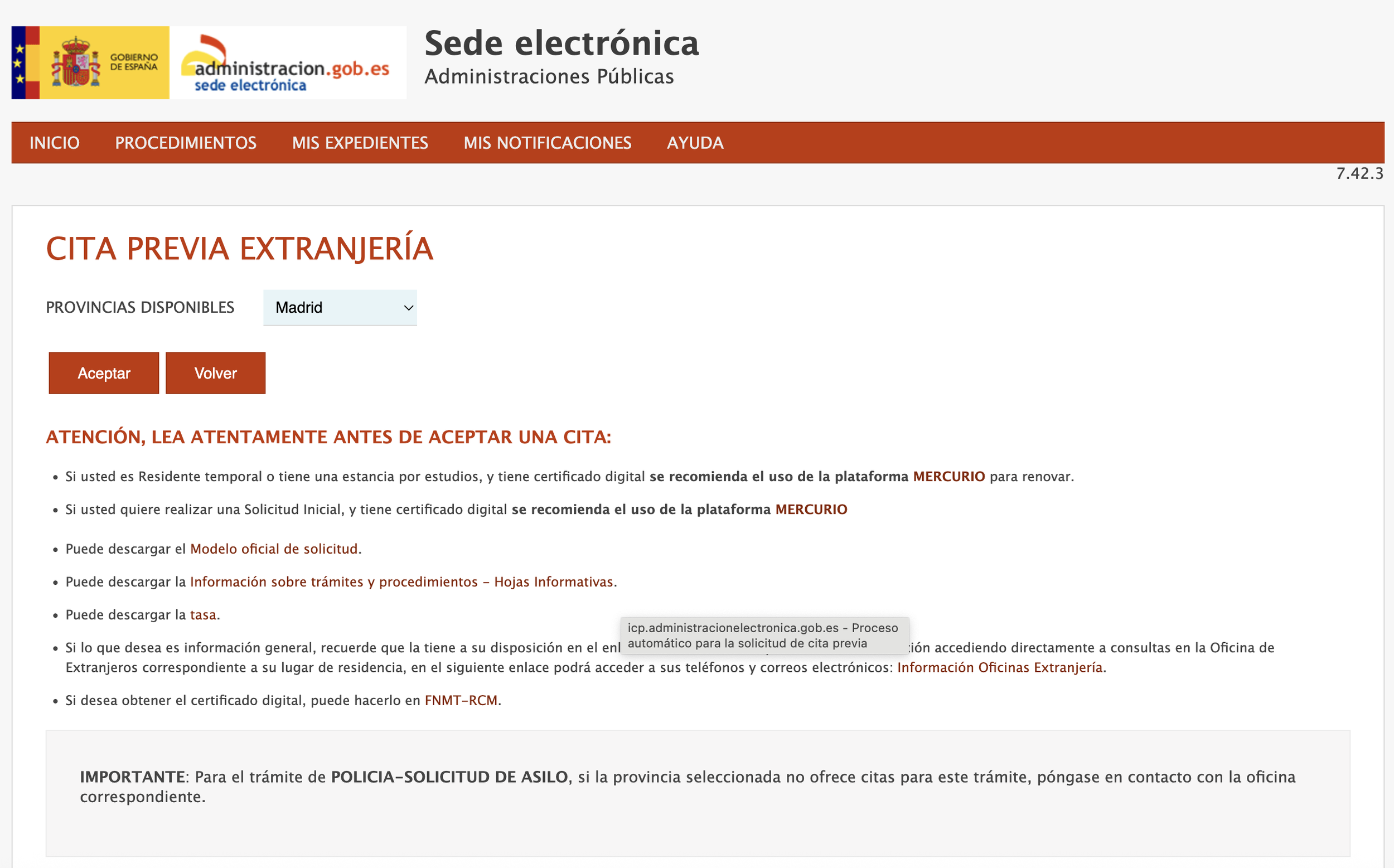
Most people fall into one of two categories:
NIE only (number without residency)
NIE linked to residency (part of a TIE application)
This affects:
Which form you use
Which appointment type you book
Sometimes which office you’re sent to
If you only need the number, you’ll usually use form EX-15.
Step 2: Book a Cita Previa (Appointment)
All NIE appointments are booked online via the official government system:
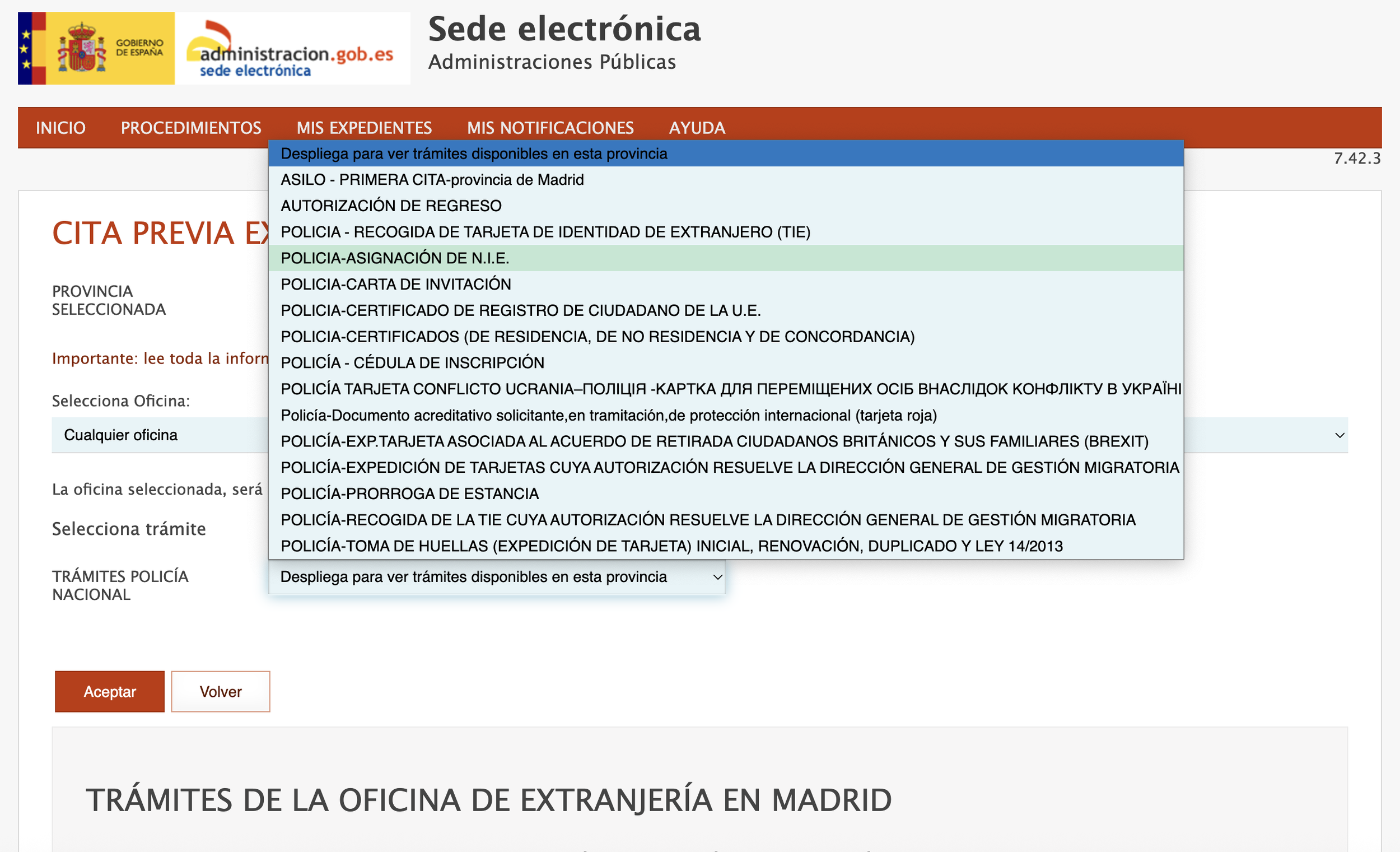
Asignación de N.I.E
Official Booking Link: Sede Electrónica - Cita Previa Extranjería
What trips people up:
Choosing the wrong option in the dropdown
Seeing “no appointments available”
If you’re applying for a NIE only, look for options like:
Asignación de NIE
Or similar wording (it can change slightly)
In Madrid, appointments are often hard to find.
That’s normal. It doesn’t mean you’re doing anything wrong.
Step 3: Fill Out the Forms
For a standard NIE application:
EX-15 form
The form is in Spanish.
Take your time and double-check:
Passport number
Name spelling
Reason for requesting the NIE
Common mistakes:
Leaving fields blank
Vague reasons like “personal matters”
Mismatched passport details
You don’t need perfect Spanish.
You do need consistency.
Step 4: Pay the Fee (Tasa)
This step is misunderstood a lot.
The NIE has a small administrative fee
It’s paid using Modelo 790-012
Payment is separate from the appointment
Official payment info:
Official Link: Modelo 790 Código 012 Payment Form
Usually you:
Fill out the form
Pay online or at a bank
Bring the stamped or confirmed receipt
If you don’t bring proof of payment, many offices won’t proceed.
Step 5: Prepare Your Documents
Bring:
Passport (original + photocopies)
Completed EX-15
Proof of why you need the NIE (work offer, bank letter, contract, etc.)
Fee payment receipt
Appointment confirmation
Bring extra copies. Always.
Even when they don’t ask for them.
Step 6: Go to the Appointment
Expect:
A waiting room
A ticket or number system
Spanish as the default language
What usually happens:
Document check
A few basic questions
Processing done fairly quickly
Waiting time can be:
10 minutes
Or over an hour
Mornings are often busier. Late morning can be calmer.
After the Appointment: What Happens Next
This varies.
Sometimes:
You receive your NIE immediately, printed on paper
Sometimes:
You’re told to return
Or download confirmation later
If you leave with a paper showing your NIE number, that’s valid.
Keep it safe. You’ll use it a lot.
Common Problems (And What Actually Helps)
No Appointments Available
If you see “no appointments available,” you didn’t do anything wrong.
This is extremely common in Madrid. Sometimes for days. Sometimes for weeks.
It’s not you.
It’s demand, understaffed offices, and a booking system that gets overwhelmed easily.
What people usually try
Checking early in the morning
Refreshing the page repeatedly
Looking once a day for cancellations
These aren’t bad ideas. They’re just not the full picture.
What actually helps (in real life)
1. Persistence (more than feels reasonable)
Most people who eventually get an appointment checked:
Multiple times a day
Over several days
Even after being convinced it was “impossible”
Appointments appear and disappear fast. You don’t see them unless you happen to be there at the right moment.
2. Checking at unusual times
New slots and cancellations don’t follow office hours.
People often find appointments:
Late at night
Mid-afternoon
Random weekday moments
There’s no magic hour. Variety helps more than routine.
3. Expanding your location search
If you’re allowed to book outside central Madrid:
Include police stations across the province
Consider nearby provinces if the system allows it
A short train ride is often easier than waiting weeks.
4. Not assuming you failed
Seeing “no appointments” feels personal. It isn’t.
The system doesn’t save progress.
It doesn’t reward effort.
It just refreshes.
Walking away and trying again later is part of the process, even though no one tells you that.
A Note on Why It’s So Hard Right Now
Madrid has:
Very high demand
Limited appointment slots
Offices that are often understaffed
On top of that, there are illegal third-party services that use automated bots to grab appointments instantly and resell them. This makes availability look worse than it actually is.
Officially, appointments are free.
If someone is charging you just to “find” one, that’s why.
This doesn’t mean you can’t get a slot on your own.
It just means patience matters more than tricks.
One Reassuring Truth
People get NIE appointments every single day.
Not because they cracked a secret system.
But because they kept going when it felt pointless.
If you’re stuck here, you’re not behind.
You’re just in the most annoying part.
Missing or “wrong” documents
Different clerks sometimes give different answers.
If you’re turned away:
Stay calm
Ask exactly what’s missing
Return with it
This happens to locals too.
Language issues
Translators aren’t always allowed
Google Translate is commonly used
Politeness matters more than fluency
You don’t need perfect Spanish.
You do need calm energy.
Good to Know Before You Leave
Bring copies. Always.
Be polite, patient, and calm.
Different answers don’t mean you messed up.
This process usually feels worse than it is.
A Calm Closing
If you’re in the middle of this and feeling behind, you’re not.
The NIE is one of those admin gates.
Once it’s done, a lot of other things get easier.
One step at a time.
Read More





Learning Spanish before moving to Spain is not about fluency. It is about navigating paperwork, appointments, and everyday admin with confidence, clarity, and far less stress.